News Story
"Smart" Fluid Controlled with Light
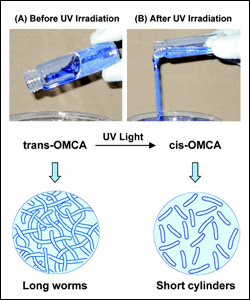
Photoresponsive (PR) fluids consisting of CTAB and OMCA. When OMCA is in its trans from, its mixture with CTAB gives rise to long, entangled wormlike micelles. Upon UV irradiation, trans-OMCA gets photoisomerized to cis-OMCA, and the corresponding change in molecular geometry causes a drastic reduction in micellar length.
Fluids capable of a state-change in response to electric fields (electrorheological, ER), magnetic fields (magnetoreheological, MR), and light (photorheological, PR) change instantly from liquids into semi-solids or gels, then back again as the stimulus is applied or removed. ER- and MR-based smart fluids are already in wide use in devices such as shock absorbers for vehicles and buildings, valves and clutches, but their light-triggered cousins have so far remained largely ignored by industry because they are typically difficult and expensive to manufacture. The Raghavan group, however, has engineered new kinds of PR fluids that can be created using inexpensive chemicals found in most labs. The researchers believe that their discovery could spur on the acceptance and use of PR fluids in commercial applications, particularly in microscale devices such as microvalves or microsensors, where light will be more effective than electrical or magnetic fields for precision control.
The group’s smart fluids contain micelles, strings of molecules that spontaneously form in water under the right conditions. Initially, the micelles are long, wormlike chains that tend to get entangled, much like a bowl of spaghetti, making the fluid thick and gel-like. Upon exposure to UV radiation, the micelles’ length is drastically reduced due to rearrangements of their constitutent molecules. The shortened micelles become untangled, and the smart fluid becomes a thin, water-like liquid, with a viscosity (thickness) that is reduced by 4 orders of magnitude (a factor of 10,000).
The Complex Fluids and Nanomaterials Group’s work on this project was funded by a seed grant from the Small Smart Systems Center (SSSC) at the University of Maryland and a CAREER award from the NSF-CTS.
Learn More:
Visit the Complex Fluids and Nanomaterials Group website »
ACS Publications' article citation »
Read the materials@nature article »
Read the ScienceDaily article »
Read the Chemical Processing article »
Download the Materials Today article (PDF) »
Published March 16, 2007
Related Stories
Stories / April 4, 2012
New Barrier Gel Will Improve Analysis of Blood Samples
Stories / November 17, 2011
New Technique Turns Alginate Solution Into Micron-Scale Gel...

Stories / August 30, 2011
Blood-Clotting "Nano-Velcro" Featured in C&EN

Stories / July 29, 2010
Raghavan Group Aids Development of Non-Toxic Oil Recovery Agent

Stories / April 8, 2009
"Nano-Velcro" Wins Outstanding Invention of the Year
Stories / Apr 19, 2024
Celebrating Asian, Pacific Islander, and Desi American Engineers

Stories / Apr 3, 2024
Next-Generation Batteries Could Come with Lower Production...
Stories / Mar 26, 2024
Maryland Researchers Awarded $1.5 Million to Pioneer Batteries...

Stories / Mar 25, 2024
Researcher’s Pacific Dive Spurred Innovations in Robotics...

Stories / Mar 4, 2024
Alumna Blasts Into Space

Stories / Feb 1, 2024
Celebrating the Impact of Black Maryland Engineers and Leaders

Stories / Jan 31, 2024
Celebrating the Life of Manfred Wuttig: Long-Time Educator,...

Stories / Jan 12, 2024
Lighter, Safer and Stronger Batteries Could Power the Smart...
Stories / Jan 9, 2024
Safer Electric Vehicles Could Come Soon After this Recent...
Stories / Nov 14, 2023
Fawole Arrives as New Lecturer, Bringing An Unconventional...